





Flashlight Battery Guide: 18650, 21700, CR123A & Every Other Size Explained
Battery confusion is the #1 reason people end up with a flashlight that doesn't work the way they expected. Two batteries can look nearly identical in size and still have completely different voltages — and using the wrong one can damage your light or, in rare cases, create a safety hazard.
This guide breaks down every battery size and chemistry you'll run into shopping for a Fenix flashlight or headlamp, so you can buy with confidence the first time.
Quick rule before anything else: never assume a battery will fit or work in your light just because it looks the right size. Always check the exact battery type listed in your flashlight's specifications before buying.
Rechargeable Lithium-Ion Batteries
Lithium-ion (Li-ion) is the standard for modern high-performance flashlights. These batteries deliver more energy density than alkaline or NiMH, hold a charge far longer in storage, and can be recharged hundreds of times.
10440 and 14500 (AA-sized)
The 14500 is built to the same physical dimensions as a standard AA battery — but don't let that fool you. A AA alkaline runs at 1.5V; a 14500 lithium-ion cell runs at 3.6–3.7V. If your light is only rated for AA alkaline batteries, putting a 14500 in it can damage the light or the battery. Always confirm your light is 14500-compatible before using one.
16340 / RCR123A
The 16340 is close in size to a CR123A lithium primary battery, but usually a bit longer, and it runs at 3.6–3.7V compared to a CR123A's 3V. Some newer 16340 batteries — like Fenix's ARB-L16-800UP — include a built-in USB-C charging port, so you can top off the cell directly without pulling it or buying a separate charger. As always, check your light's spec sheet before swapping a 16340 in for a CR123A.
18650
The 18650 is one of the most widely used battery sizes in flashlights, headlamps, and vape devices, and it's the backbone of many mid-size, high-output Fenix lights. Fenix's 18650 lineup includes standard button-top cells (ARB-L18-4000) and USB-C rechargeable versions (ARB-L18-4000U) that charge in the light or standalone via cable. Typical capacities run 2,000–4,000mAh depending on the cell.
21700
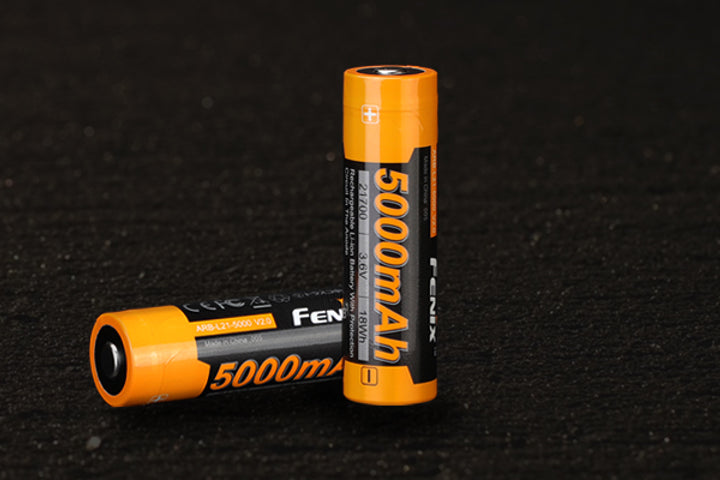
The 21700 is the newer, larger sibling of the 18650 — roughly the same diameter with more length, which translates to roughly double the capacity in a single cell. It's become the standard battery for Fenix's higher-output flashlights, including the PD36R, TK22 V2.0, TK16 V2.0, LD35R, and HT18R. Many current Fenix 21700 batteries (like the ARB-L21-5000U and ARB-L21-6000B) have USB-C charging built into the cell itself, and some — like the 6000B — can even double as a small power bank for charging your phone. If you're buying a new high-lumen light, there's a good chance it takes a 21700.
Important: not all 21700 batteries are interchangeable across Fenix models. Some newer flashlights released in 2025 and later require the updated 6000B-style cell and aren't compatible with earlier 21700 batteries such as the original PD36R V1 cell. Always check your specific flashlight model's compatible battery before buying.
26650
The 26650 is the largest common flashlight battery size, with a larger diameter and greater length than an 18650 or 21700. That extra volume means higher capacity and the ability to sustain high current draw, which is why you'll find 26650 cells in searchlights and other high-drain, long-runtime flashlights.
Lithium Primary Batteries (CR123A)
CR123A batteries are non-rechargeable lithium cells found in AAA, AA, 9-volt, and the small cylindrical CR123A size. Their standout advantage is shelf life — thanks to a slow self-discharge rate, a CR123A can sit in storage for up to 10 years depending on the brand, and it performs reliably in below-freezing temperatures. That makes it a strong choice for a light that lives in a bug-out bag, glovebox, or emergency kit and needs to work the moment you grab it, even after months untouched.
Rechargeable NiMH/NiCd Batteries
Nickel-metal hydride (NiMH) and nickel-cadmium (NiCd) rechargeables come in AAA, AA, C, D, 9-volt, and 12-volt sizes. They're a solid, affordable all-around option — but they have a shorter shelf life than lithium-ion and will self-discharge faster in storage, so they're better suited to lights you use regularly rather than ones sitting in an emergency kit.
Alkaline Batteries
Alkaline batteries are the most common and least expensive option, available in AAA, AA, C, D, 9-volt, and button cell sizes. They're not rechargeable, and they carry two real downsides:
- They can leak, which can permanently damage your flashlight. If you're not using the light often, store alkaline batteries outside the device rather than leaving them installed — and if you do keep them in, power the light on roughly once a week to reduce (though not eliminate) leak risk.
- Lower power output than lithium-ion, which means shorter runtime and reduced maximum lumen output compared to what the same light can produce on a lithium-ion cell.
Protected vs. Unprotected Batteries
With the exception of alkaline batteries, always buy protected lithium-ion batteries. Protected cells have built-in circuitry that guards against overcharging, over-discharging, and overheating — all of which can shorten battery life or create a safety risk in unprotected cells. Fenix batteries include three layers of protection built in.
For a deeper breakdown of what "protected" actually means and why it matters, see our full guide: Protected vs. Unprotected 18650 Batteries.
Frequently Asked Questions
Can I use a 16340 battery instead of a CR123A?
Only if your flashlight's specifications say it accepts 16340/CR123A batteries. The voltages are different (3.6–3.7V vs. 3V), and using the wrong one in an incompatible light can cause damage.
What's the difference between an 18650 and a 21700 battery?
A 21700 is larger than an 18650 in both diameter and length, giving it roughly double the capacity. Higher-output modern flashlights increasingly use 21700 cells to support their higher lumen levels and longer runtimes.
Do I need a separate charger for my flashlight battery?
Not always. Many current Fenix batteries — in 16340, 18650, and 21700 sizes — have a USB-C charging port built directly into the cell, so you can charge them with any USB-C cable. Standard (non-USB) cells still require a compatible external charger.
Is it safe to store batteries inside my flashlight?
For lithium-ion, generally yes, since they have a much slower self-discharge rate. For alkaline batteries, it's safer to store them outside the device when it's not in regular use, since alkaline cells are more prone to leaking.
Shop lights by battery size: 21700 · 18650 · 16340 · CR123A · AA · AAA
Not sure which battery your light takes? Check the Accessory Compatibility Chart or reach out to our team — we're happy to help.

